Can Passengers Drink Alcohol in a Car? Rules by Region and State
Last updated
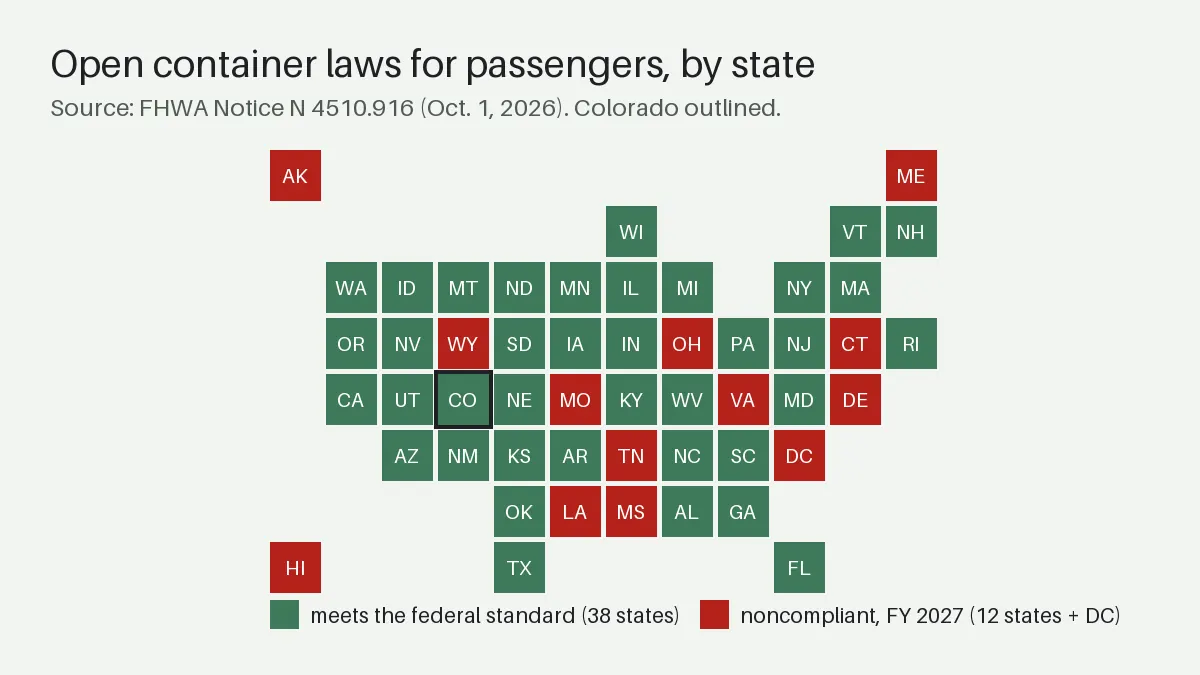
For a typical trip, the answer is no. The 38 states that satisfy federal rules keep every occupant, passengers included, from drinking or keeping an opened alcoholic beverage within reach while the car is on a public road, and Washington, DC and several other states have passenger bans of their own. Only six states, Connecticut, Delaware, Mississippi, Missouri, Tennessee and Virginia, lack any statewide rule that would stop a sober passenger from drinking, although local ordinances can still apply there. A few other states sit in between, with laws that punish the driver for a passenger's drink or that federal officials judge incomplete.
Everything here was checked in October 2026 against federal law, the Federal Highway Administration's latest compliance list and the state codes. These rules are amended often, so verify the statute and any city ordinance before relying on a single entry.
What federal law requires
Federal involvement dates to TEA-21, the Transportation Equity Act for the 21st Century, which Congress passed in 1998. The provision is 23 U.S.C. 154, and NHTSA and FHWA implement it through 23 CFR Part 1270. It works on states, not on drivers or riders: there is no federal ticket for a passenger with a beer.
To satisfy 23 CFR 1270.4, a state statute must meet these conditions:
- It forbids both possession of any opened alcoholic beverage container and consumption of alcohol in a vehicle's passenger area.
- It reaches each occupant, driver included, and all kinds of alcoholic beverages.
- It covers all motor vehicles on a public highway or within the highway right-of-way.
- It is enforced as a primary offense, so no other violation is needed for a stop.
Federal rules tolerate a short list of carve-outs. Passengers, but never the driver, may be exempted in a vehicle designed, maintained or used chiefly to carry paying passengers, including buses, taxis and limousines, and in the living quarters of a house coach or house trailer. An opened container may also be allowed when it is locked away, for example in a locked glove box, or, when a vehicle has no trunk, in the area behind the final upright seat or in a place the driver and riders do not normally occupy.
The penalty for falling short is a redirection of highway money. On October 1 of each fiscal year, FHWA reserves 2.5 percent of a noncompliant state's apportionments under the National Highway Performance Program and the Surface Transportation Block Grant Program, and the state elects how to divide it between Section 402 alcohol-impaired driving programs and Highway Safety Improvement Program activities. FHWA Notice N 4510.916, issued October 1, 2026 for fiscal year 2027, applies the reservation to the twelve states marked "Fails federal standard" in the table below and to the District of Columbia. A year earlier, Notice N 4510.905 named those twelve states and left DC off.
State-by-state rules, grouped by region
Regions follow the Census Bureau's four groupings. "Meets federal standard" means FHWA reserved no Section 154 funds for fiscal year 2027. The citation column links to official state code pages; the Georgia, New Jersey and New Mexico links go to the official code portal, because those publishers have no fixed address per section.
| Region | State | Rule for passengers | Source |
|---|---|---|---|
| Northeast | Connecticut | Allowed statewide; the statute only stops a driver from drinking. Fails federal standard. | 53a-213 |
| Northeast | Maine | Operator is liable when a rider drinks or has an opened container. Fails federal standard. | Title 29-A, 2112-A |
| Northeast | Massachusetts | Banned within the passenger area. Meets federal standard. | Chapter 90, 24I |
| Northeast | New Hampshire | Banned under a paragraph aimed at passengers. Meets federal standard. | 265-A:44 |
| Northeast | New Jersey | Riders may not drink. Meets federal standard. | 39:4-51a and 39:4-51b |
| Northeast | New York | Banned for operators and riders. Meets federal standard. | VTL 1227 |
| Northeast | Pennsylvania | Banned for any occupant. Meets federal standard. | Title 75, 3809 |
| Northeast | Rhode Island | Driver is cited for an unsealed container in the passenger section. Meets federal standard. | 31-22-21.1 |
| Northeast | Vermont | Banned through a rider-specific section. Meets federal standard. | Title 23, 1134 and 1134a |
| Midwest | Illinois | Banned; drivers and riders each have a subsection. Meets federal standard. | 625 ILCS 5/11-502 |
| Midwest | Indiana | Banned for a person in the passenger compartment. Meets federal standard. | IC 9-30-15-3 |
| Midwest | Iowa | Banned; a rider section sits beside the driver section. Meets federal standard. | 321.284 and 321.284A |
| Midwest | Kansas | Banned from transport in the cabin unless sealed or stowed. Meets federal standard. | 8-1599 |
| Midwest | Michigan | Banned for any occupant. Meets federal standard. | 257.624a |
| Midwest | Minnesota | Banned on streets and highways. Meets federal standard. | 169A.35 |
| Midwest | Missouri | Allowed statewide; only a driver drinking while moving commits an infraction. Fails federal standard. | 577.017 |
| Midwest | Nebraska | Banned for occupants. Meets federal standard. | 60-6,211.08 |
| Midwest | North Dakota | Banned, including in public parking areas. Meets federal standard. | 39-08-18 |
| Midwest | Ohio | Banned, except limousine riders and pedal-pub riders within limits. Fails federal standard. | 4301.62 |
| Midwest | South Dakota | Banned for anyone occupying the car. Meets federal standard. | 35-1-9.1 |
| Midwest | Wisconsin | Banned on highways. Meets federal standard. | 346.935 |
| South | Alabama | Banned in the passenger area. Meets federal standard. | 32-5A-330 |
| South | Arkansas | Banned anywhere a person sits. Meets federal standard. | 5-71-218 |
| South | Delaware | Allowed statewide; the law covers driver consumption only. Fails federal standard. | Title 21, 4177J |
| South | District of Columbia | Banned in vehicles on streets, alleys, parks or parking areas. Added to the federal list for FY 2027. | 25-1001 |
| South | Florida | Banned for operators and riders. Meets federal standard. | 316.1936 |
| South | Georgia | Banned in the passenger area. Meets federal standard. | 40-6-253 |
| South | Kentucky | Banned for possession in the passenger area. Meets federal standard. | 189.530 |
| South | Louisiana | Mostly banned; exceptions include lidded frozen drinks and parade floats. Fails federal standard. | 32:300 |
| South | Maryland | Banned for occupants. Meets federal standard. | Criminal Law 10-125 |
| South | Mississippi | Allowed statewide; no state vehicle open container law, local rules possible. Fails federal standard. | FHWA notice; NHTSA digest |
| South | North Carolina | Banned; a violation of 20-138.7 is an infraction, while opened spirits or fortified wine fall under a misdemeanor in 18B-401. Meets federal standard. | 20-138.7 and 18B-401 |
| South | Oklahoma | Banned in a moving vehicle. Meets federal standard. | Title 21, 1220 |
| South | South Carolina | Banned for open beer or wine unless it is in the trunk; liquor is covered separately. Meets federal standard. | 61-4-110 |
| South | Tennessee | Allowed statewide; covers drivers, but localities may extend it. Fails federal standard. | 55-10-416 |
| South | Texas | Banned in the passenger area. Meets federal standard. | Penal Code 49.031 |
| South | Virginia | Allowed statewide; only the driver is barred, and an opened drink can create a presumption. Fails federal standard. | 18.2-323.1 |
| South | West Virginia | Banned for operators and riders. Meets federal standard. | 17C-5D-3 |
| West | Alaska | Driver commits the infraction if an opened container is in the cabin. Fails federal standard. | 28.35.029 |
| West | Arizona | Banned for anyone in the passenger compartment. Meets federal standard. | 4-251 |
| West | California | Banned; riders may neither drink nor keep one. Meets federal standard. | Vehicle Code 23221 and 23223 |
| West | Colorado | Banned for any person in the passenger area. Meets federal standard. | 42-4-1305 |
| West | Hawaii | Banned under a passenger section. Fails federal standard. | 291-3.2 |
| West | Idaho | Banned for every person riding on a highway. Meets federal standard. | 23-505 |
| West | Montana | Banned on highways. Meets federal standard. | 61-8-1026 |
| West | Nevada | Banned; a misdemeanor in the passenger area. Meets federal standard. | 484B.150 |
| West | New Mexico | Banned for all occupants on highways. Meets federal standard. | 66-8-138 |
| West | Oregon | Banned; drinking and possession are separate violations. Meets federal standard. | 811.170 |
| West | Utah | Banned whether moving, stopped or parked on a highway. Meets federal standard. | 41-6a-526 |
| West | Washington | Banned; each is a traffic infraction. Meets federal standard. | 46.61.519 |
| West | Wyoming | Banned only while moving, and city ordinances take over inside town limits. Fails federal standard. | 31-5-235 |
Exceptions that come up again and again
- Hired rides such as limousines and party buses. Paying passengers in vehicles that mainly carry people for compensation are frequently exempt, while the driver stays covered. Colorado also leaves the front seat passenger under the ban.
- Motor homes. The living quarters of an RV are a common exemption, though Wyoming instead requires alcohol to stay locked in a cabinet or compartment during travel.
- Locked or out-of-reach storage. Putting an opened bottle in the trunk is the usual answer. Without a trunk, many states accept the zone behind the final upright seat, and a few also accept a locked glove box. Check which of these your state actually lists.
- City and county ordinances. Local governments can impose stricter rules. Tennessee and Mississippi leave explicit room for them, and Wyoming's state law does not apply inside a municipality that has its own open container ordinance.
Related legal points
The driver's exposure. A few statutes put the citation on the person driving. That is how Alaska, Maine and Rhode Island are written. Independently of those rules, a driver who drinks enough to be impaired risks a DUI charge.
Riding with someone who has been drinking. A passenger's own drink and a driver's intoxication are distinct issues. A sober rider usually breaks no open container law simply by being in the car, but the driver answers under DUI law, and certain states also punish handing your vehicle to someone you know is intoxicated.
Uber and other rideshare services. Uber states in its community guidelines that open containers of alcohol are never allowed while using its apps, which means a rider can lose the account even where no state ban exists. Statutes differ on whether a personal vehicle driven for rideshare qualifies as one used "primarily" for transporting people for compensation, and states have not answered that the same way, so the limousine exemption should not be assumed.
Colorado note
Colorado addresses the issue in C.R.S. 42-4-1305. A person sitting in a motor vehicle's passenger area may not knowingly drink alcohol or possess an opened alcoholic beverage container when the vehicle is on a public highway or the highway right-of-way. The offense is a class A traffic infraction carrying a fifty dollar fine and a statutory surcharge.
Exemptions are tight. In a vehicle used primarily for paid passenger transport, riders may drink, except the driver and the front seat passenger. Riders other than those two may keep an opened drink inside a motor home's or house coach's living quarters. A vehicle with no trunk may hold it behind its rearmost upright seat or in a spot where no one normally sits. Because the definition of passenger area names the glove compartment and the statute gives no locked glove box exemption, that spot is not a safe harbor in Colorado. Denver and other municipalities may enact their own ordinances as long as they are at least as strict as the state rule.
Sources and how to check current law
- Open container statute, 23 U.S.C. 154
- Implementing regulation, 23 CFR Part 1270 (eCFR)
- FHWA N 4510.916, fiscal year 2027 apportionments and Section 154 list
- FHWA N 4510.905, fiscal year 2026 apportionments and Section 154 list
- NCSL table of state open container and consumption laws
- NHTSA digest of impaired driving laws, 30th edition
Each October, FHWA publishes a fresh apportionment notice, and its Section 154 paragraph is the quickest way to see which jurisdictions currently fall short. After that, read the statute on the state's official code site and look up any ordinance where you will travel.